If you’ve imported beef from Australia, Brazil, or the US, the specs are familiar. Carcass weights are heavy, cut yields are predictable, and the IMPS/AUS-MEAT codes are universal.
Pakistani beef and buffalo trade differently. Carcass weights are smaller, the cut nomenclature blends international and South Asian conventions, and yield ratios shift depending on whether you’re buying chilled bone-in for the Gulf or boneless trim for processing. Specs that would be standard for a US buyer are sometimes negotiable here — and that flexibility is either a feature or a liability depending on whether your sourcing partner knows the territory.
This guide walks through the cut profile most international buyers will actually deal with when sourcing from Pakistan in 2026.
Carcass weight: the starting point
Two structural facts about Pakistani beef shape every cut spec downstream:
- Average beef carcass dressed weight: ~125 kg
- Average buffalo carcass dressed weight: ~196 kg
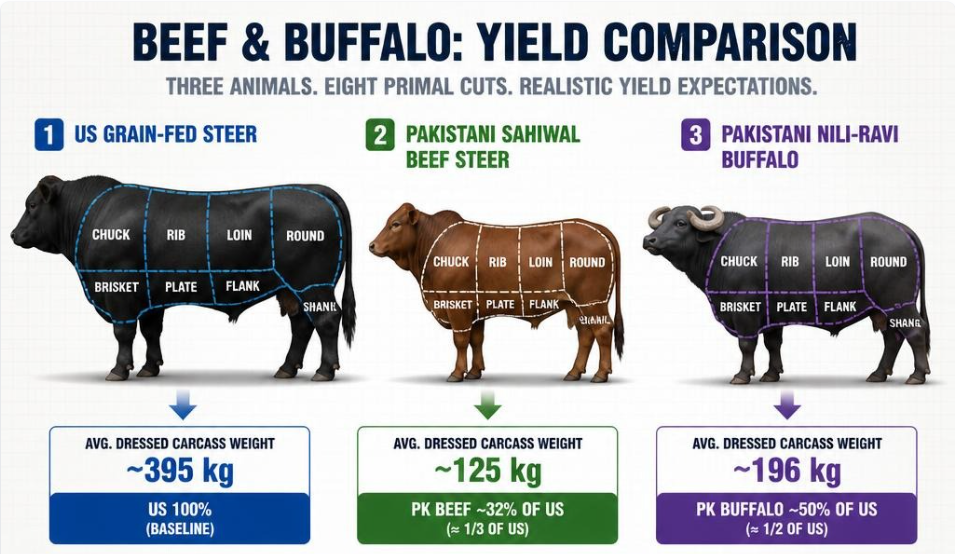
Both are roughly 30-40% lighter than Australian Angus (~340 kg) or US grain-fed (~395 kg). This isn’t a quality issue — it reflects smallholder farming, predominantly grass-fed rearing, and a different breed mix dominated by Sahiwal, Cholistani, and crossbreds for beef, and Nili-Ravi and Kundi for buffalo.
What it means for buyers:
- Cut sizes are smaller. A Pakistani striploin will run 2.8-3.5 kg vs 4.5-6 kg from an Australian carcass.
- Yields per container are lower by carcass count. Plan MOQ conversations around weight, not head count.
- Cut consistency requires sorting. Reputable suppliers sort to weight bands (e.g., 2.5-3.0 kg, 3.0-3.5 kg) on request — but you have to specify this upfront.
The primal cuts
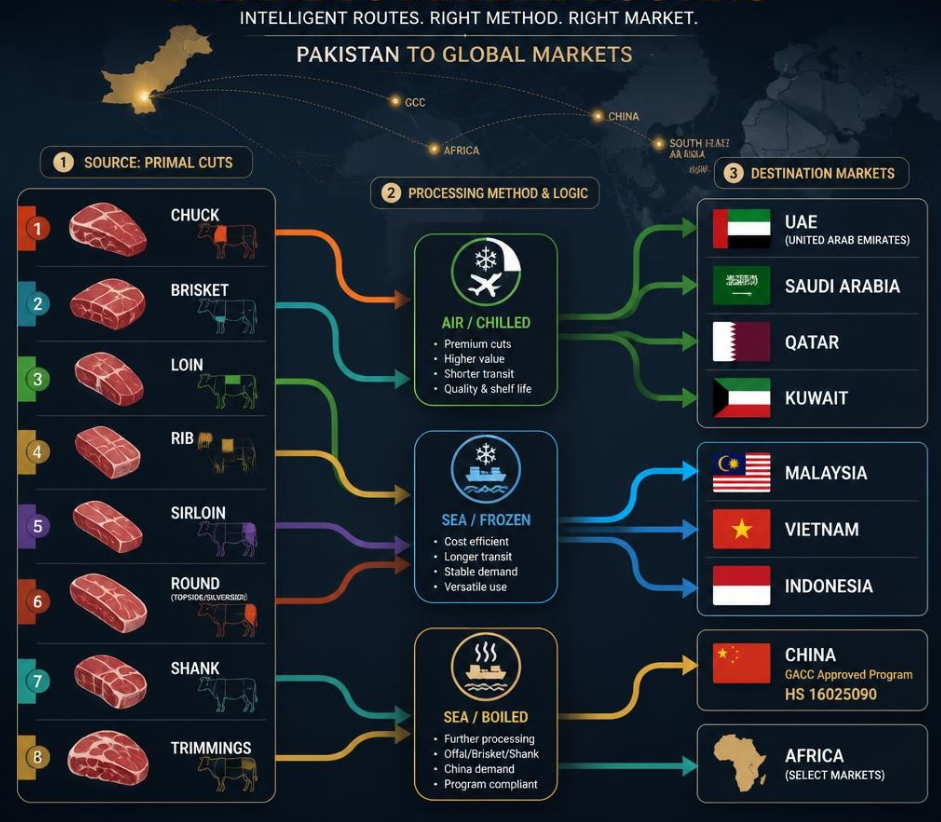
Pakistani plants typically break carcasses into eight primal cuts following a hybrid HACCP/halal standard. The naming is mostly international, with some local terminology in domestic-facing documents.
Forequarter primals
1. Chuck (shoulder)
- Yield: ~22-24% of carcass
- Typical weight: 28-32 kg per side
- Best for: ground beef, slow-cooked dishes, processing
- Export markets: GCC for shawarma trade, Central Asia for stewing
2. Brisket
- Yield: ~7-8%
- Typical weight: 9-11 kg per side
- Best for: boiled/smoked product, processing
- Export markets: Strong China demand for boiled beef program
3. Rib (forerib)
- Yield: ~9-10%
- Typical weight: 11-13 kg per side
- Best for: ribeye, prime rib, bone-in roasts
- Export markets: GCC HORECA, premium retail
4. Shank/shin
- Yield: ~4-5% (fore + hind combined often quoted together)
- Best for: stewing, soup bones, processing
- Export markets: GCC traditional cuisine, broth/stock industries
Hindquarter primals
5. Loin (short loin + sirloin)
- Yield: ~9-11%
- Typical weight: 12-14 kg per side combined
- Best for: striploin, tenderloin, T-bone
- Export markets: Premium GCC retail, hotel chains, expat-targeted segments
6. Rump
- Yield: ~5-6%
- Best for: rump steak, rump roasts
- Export markets: GCC retail, Malaysia (when bone-in restrictions allow)
7. Topside / silverside / knuckle (round)
- Combined yield: ~22-24%
- Best for: roasts, deli, processing, jerky
- Export markets: Largest export volume cut — China cooked-beef, Central Asia frozen, GCC chilled
8. Flank
- Yield: ~3-4%
- Best for: stir-fry strips, processing
- Export markets: Asian retail, value-added processors
Buffalo-specific notes
Buffalo carcasses produce slightly leaner cuts with denser muscle fiber and lower marbling. The same primals apply, but buyers should specifically note:
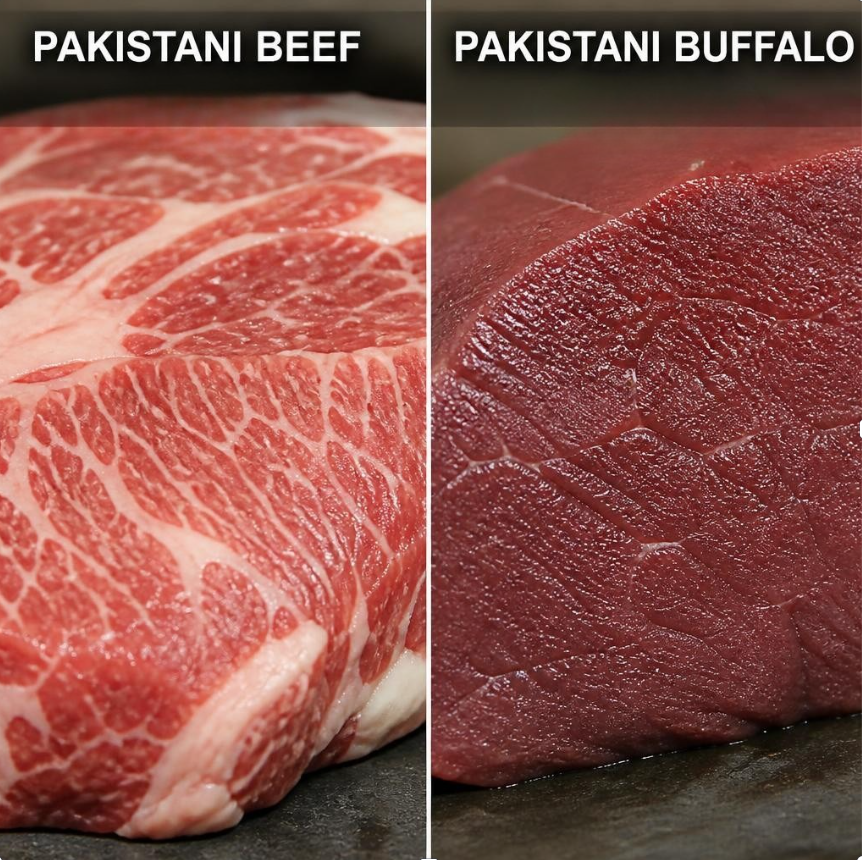
- Chuck and topside are the workhorses — together they make up the bulk of frozen boneless buffalo exports to Vietnam, Central Asia, and Malaysia.
- Buffalo loin cuts are leaner and benefit from short marination cycles — a point worth flagging to retail buyers unfamiliar with the meat.
Bone-in vs boneless: the export decision
This is where Pakistani sourcing diverges most from other origins.
Bone-in product is preferred in:
- GCC chilled trade (cultural preference, traditional butchery)
- Parts of Africa
- Some HORECA segments
Boneless product is required for:
- China (boiled beef program — strict spec)
- Most Central Asian frozen contracts
- Malaysia (bone-in restrictions tied to FMD compartmentalization)
- Vietnam transit trade
- Any processing buyer (sausage, deli, ready-meals)
Pakistan’s FMD endemic status means bone-in shipments require specific zone-of-origin documentation for many destinations. Buyers should confirm at the order stage whether their destination market accepts bone-in product, and whether the source facility is in a recognized disease-control compartment.
Chilled vs frozen: choose by destination
| Mode | Typical Markets | Shelf Life | Logistics |
|---|---|---|---|
| Chilled (vacuum-packed) | UAE, Saudi, Kuwait, Qatar, Bahrain | 60-75 days | Air freight from KHI |
| Frozen (-18°C) | China, Malaysia, Central Asia, Africa | 12-18 months | Sea freight, reefer container |
| Boiled/cooked | China (HS 16025090) | 12+ months | Sea freight |
Chilled product commands a 15-25% price premium but locks you into air-freight logistics — which means exposure to airspace disruptions like the March 2026 Middle East closures that briefly halted Gulf-bound chilled shipments.
Cut specs international buyers should always confirm
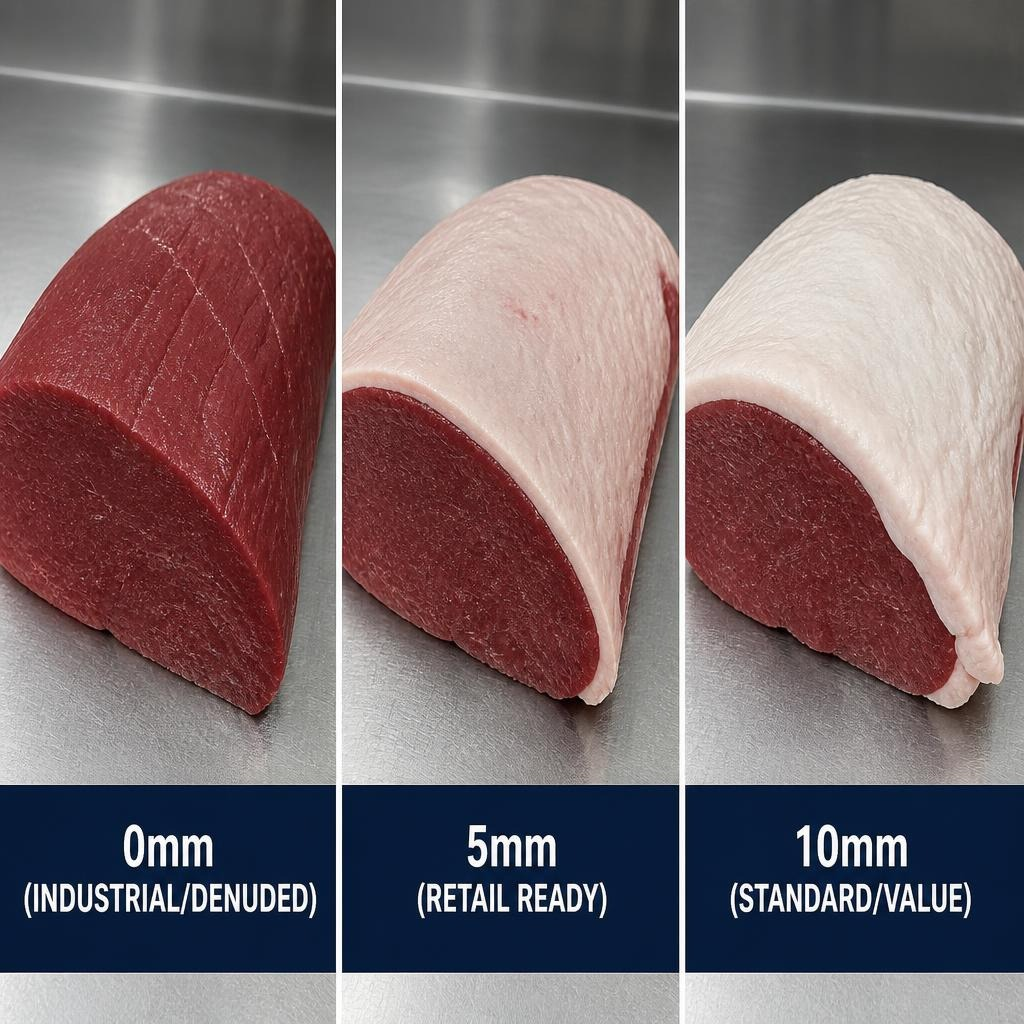
Before issuing an LC, lock down the following in writing:
- Carcass weight band (e.g., 110-140 kg dressed, 160-220 kg buffalo)
- Cut weight band (per piece, in kg)
- Trim level (typically expressed as fat cap — 0mm, 5mm, 10mm)
- Bone-in vs boneless
- Chilled (and at what core temp on arrival) or frozen
- Packaging — vacuum-pack with absorbent pad, master carton spec, kg/carton
- Halal certification body required for your destination (PHA, PHDA-JAKIM, SANHA, etc.)
- Health certificate origin — DVM signature, slaughter date, expiry
- Plant approval number matching your destination market (SFDA, GACC, JAKIM list)
Skipping any of these turns into a customs clearance problem. Most clearance issues at GCC, Malaysian, or Chinese ports trace back to mismatches between what the buyer expected and what the facility’s standard pack actually shipped.
What this means for first-time buyers
Pakistani beef and buffalo are more flexible than buyers used to working with US/Australia originate-of-origin specs are accustomed to. That flexibility is genuinely useful — you can negotiate cut weights, trim levels, and pack formats far more easily than with major-origin commodity beef.
But “flexible” only works if your sourcing partner knows which facility can deliver which spec, in which mode, for which market. The wrong combination — say, bone-in chilled to a market that requires boneless boxed — is what turns an LC into a dispute.
The right approach: define your spec by your end-market’s requirements first, then match it to a facility approved for that destination. Most experienced Pakistani sourcing partners will work backwards from the destination port rather than from any single plant’s standard offer.
Need help defining a cut spec that matches your destination market? AbuUmar works with multiple certified processing facilities across Pakistan and routes orders by destination requirement. Send us your destination and target spec and we’ll come back with a matched facility recommendation.